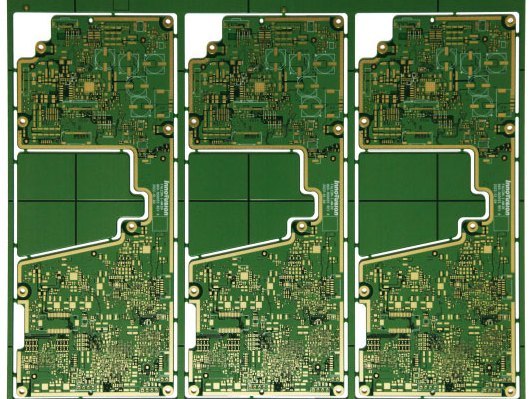
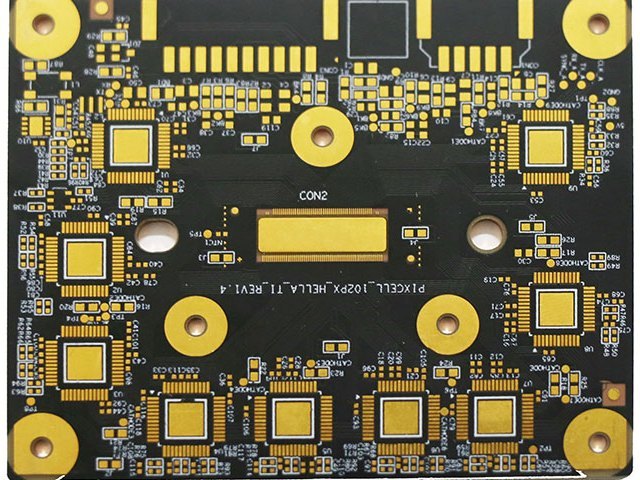
Start with the observation that a PCB price is a curve, not a multiple. One layer to two is roughly a doubling: the material is duplicated and a second imaging and plating operation is added. Four to six is a different order of change, because the board now has to be laminated as a single construction with prepreg and core material between the copper, and everything downstream happens on a thicker, more expensive piece of work. A quotation that scales linearly with layer count is not a quotation that has been thought about.
A practical way to estimate sensitivity is to build the price in three parts. Material scales with the stack-up: dielectric type, core thickness, finished copper weight and the number of cores. Process scales with the route: lamination cycles, drilling time and count, plating thickness, and imaging passes. Test and documentation scale with what the design asks to be verified — impedance coupons, X-ray inspection of blind vias, and the volume of netlist testing. When a quotation is requested with those three lines separated, the layer count effect becomes visible instead of theoretical.
The second question is whether the design needs the layers it has. A split plane for power and signal often forces a fourth or sixth layer, but so do routing density, return-path continuity and the impedance targets. Before accepting the layer count, ask what each added layer is actually carrying. A layer that exists only to escape a tight BGA, or to satisfy a split that a routing change would remove, is the layer most worth challenging. Two single-sided designs are rarely cheaper than one four-layer board, but a four-layer board that only needs two is a very common and very avoidable cost.
Finally, compare quotations on the stack-up rather than on the layer number. Two suppliers quoting six layers are quoting different materials, different copper weights and different test obligations unless the specification says otherwise. Fix the stack-up, the finished copper weight, the surface finish, the impedance requirement and the test scope in the document you send, and the comparison becomes a comparison of manufacturing rather than of guesswork.